The Oxford English Dictionary describes Kitsch as: “art, objects, or design considered to be in poor taste because of excessive garishness or sentimentality, but sometimes appreciated in an ironic or knowing way”. In German it means “trash”.
The term was used pejoratively from the 1920s to describe art that was often mass-produced and was pleasing but a bit mediocre and superficial. The advent of Pop Art in the 1950s marked a change in how we look at mass-produced art. Warhol’s tins of Cambell’s Soup and Marilyn Munroe prints typify popular culture and commercialism and artists since then have worked hard to break down the boundaries between what is perceived as high and low-brow art. Nowadays Kitsch is a more positive term. Kitsch art is everywhere. Who doesn’t love a Highland Coo painting or a gold, waving cat?
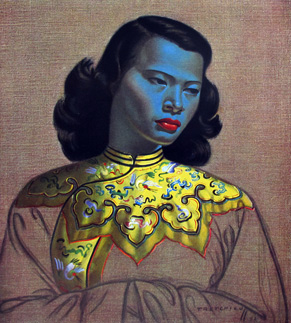
I’m going to look at a famous example of Kitsch art and why it was defined as such. The Chinese Girl by Vladimir Tretchikoff was painted in 1951 and became one of the most mass-produced and popular images of it’s time. If you were around in the 60s and 70s, you probably knew someone who had it on their wall.
The famous art critic Clement Greenberg stated in 1939 that “Kitsch is mechanical and operates by formulas. Kitsch is a vicarious experience and faked sensation. Kitsch changes according to style but remains always the same. Kitsch is the epitome of all that is spurious in the life of our times. Kitsch pretends to demand nothing of its customers except their money, not even their time” (Greenberg, 1992,10).
The Chinese Girl was kitsch, primarily because of the pleasant subject. It doesn’t demand any further reflection like an Avant Garde artwork would demand. In the Chinese Girl, a beautiful girl looks off to the side, there is no direct gaze to consider. She does not look poor or ugly or raise any unpleasant questions about what she is doing. She is painted in a realistic style and her features are where they should be unlike the abstract styles of the Avant Garde.
The girl embodies the exotic which in 1951 was a popular subject. The first commercial flights became available in the early 1950’s and foreign travel was for the first time easy and quick enough for a great number of people. To travel to exotic lands would seem sophisticated and exotic subjects in art would have appealed, reflecting the public aspirations.
However, despite the fact the girl is Chinese, Tretchikoff has depicted her in a westernised style. Her elaborate robe is foreign, but she has bright red lipstick and a glamorous Hollywood hair style. She is, therefore, idealised and non-threatening to a public who had only experienced the Chinese culture in books and films.
Despite its unchallenging style, there are some elements of the painting which have been used by Avant Garde artists in the past and would make the buyer feel they might be buying something more edgy and sophisticated: the girl’s face is a strange blue-green colour perhaps reminiscent of Picasso’s use of blue in portraits. Gauguin had painted many paintings of Tahitian women 50 years previously, at the time, this was shocking. The unfinished raw canvas is unusual and could be compared to the unfinished paintings of the great masters (these artists would not have intended their work to be seen like this, however, due to their importance, curators included unfinished works in their collections, which the public may be aware of). Although unusual in their time, these aspects would have become more acceptable and filtered through to popular culture, making the public believe they were modern and sophisticated if they bought it.
Tretchikoff created this image to be popular, the painting was reproduced in great numbers and it became one of the most reproduced images in the world. One of Greenberg’s definitions of kitsch is that it “can be turned out mechanically”. While he might be referring to the effort that the artist puts in, an image mass-produced by a press is the epitome of mechanical.
 Kim Appleton Art & Framing